
Index
- Introduction
- Executive Snapshot: NSE IPO Key Metrics & Overview
- The Mega Issue – Background, Regulatory History & SEBI Clearance
- Why Has the NSE IPO Been Delayed for Nearly a Decade?
- Current SEBI NOC & Cross-Listing Requirement
- Financial Powerhouse Analysis – Business Model & Key Indicators
- Key Performance Indicators (KPI Financial Metrics)
- Unlisted Market Dynamics & Valuation Benchmarking
- Key Growth Catalysts & Regulatory Risk Factors
- Decision-Tree Scenarios & Future Possibilities (2026 Listing Horizon)
- Actionable Investor Playbook
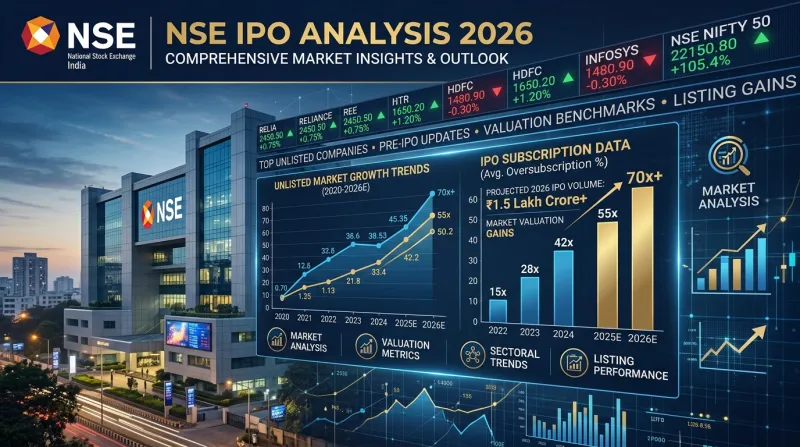
NSE IPO latest updates
 By Admin
|
Sep 13, 2026
|
1 min read
|
1
|
🤍
0
By Admin
|
Sep 13, 2026
|
1 min read
|
1
|
🤍
0
The National Stock Exchange of India (NSE) IPO is arguably the most eagerly awaited public listing in Indian capital markets over the past decade. Founded in 1992 and operationalized in 1994 as India's first dematerialized electronic exchange, NSE revolutionized financial markets by replacing physical pit trading with screen-based automated order matching.
Executive Snapshot: NSE IPO Key Metrics & Overview
| Key Parameter | Current Status / Estimate (2026) | Market Significance & Analytical Context |
|---|---|---|
| Expected Issue Size | ₹15,000 Cr – ₹30,000 Cr | Set to be one of the largest Offer for Sale (OFS) issues in Indian capital market history |
| Estimated Market Cap | ₹3.8 Lakh Cr – ₹4.8 Lakh Cr | Positioned among the top 15 most valued listed companies in India |
| SEBI Regulatory Status | No-Objection Certificate (NOC) Pending | Resolution of past legal disputes completed; final governance audit under SEBI review |
| Listing Exchange | BSE Limited (Cross-Listing) | Under SEBI rules, a stock exchange cannot list on its own platform; cross-listing on BSE is mandatory |
| Cash Segment Market Share | ~93.5% | Near-monopolistic dominance in Indian cash equity turnover |
| Equity Derivatives Share | ~98.2% | Unrivaled leadership in global and domestic stock & index options trading |
| EBITDA Margin Profile | >75% | Industry-leading operational efficiency and capital light business architecture |
| Return on Equity (ROE) | ~34% - 38% | Exceptional profitability driven by scalable exchange tech infrastructure |
The Mega Issue – Background, Regulatory History & SEBI Clearance
The National Stock Exchange of India (NSE) IPO is arguably the most eagerly awaited public listing in Indian capital markets over the past decade. Founded in 1992 and operationalized in 1994 as India's first dematerialized electronic exchange, NSE revolutionized financial markets by replacing physical pit trading with screen-based automated order matching.
Why Has the NSE IPO Been Delayed for Nearly a Decade?
- The Co-location Case: In 2016–2017, allegations emerged regarding preferential access to algorithmic traders placed closer to exchange servers (co-location servers). SEBI launched extensive investigations, disgorgement orders, and legal proceedings.
- Legal Settlements & Disgorgements: Over the subsequent years, NSE resolved pending litigations, paid regulatory settlements, overhauled senior management, and restructured its technology governance.
- Corporate Governance Revamp: Under SEBI mandate, NSE reformed its Governing Board, enhanced independent director representation, and instituted transparent technology auditing mechanisms.
Current SEBI NOC & Cross-Listing Requirement
NSE re-applied to the Securities and Exchange Board of India (SEBI) for a No-Objection Certificate (NOC) to proceed with its IPO filing.
IMPORTANT
Mandatory Cross-Listing Regulation: Under SEBI Market Infrastructure Intermediaries (MII) regulations, a stock exchange cannot list its shares on its own platform. Therefore, NSE will list exclusively on its competitor, BSE Limited, while BSE's shares continue to trade on NSE.
Track live regulatory developments and listing schedules on the InvesTalks IPO Radar.
Financial Powerhouse Analysis – Business Model & Key Indicators
NSE operates a high-margin, network-effect business model where higher trading volume directly expands profitability without requiring proportionate capital expenditure.
1. Revenue Engine Breakdown
- Transaction Charges (Primary Driver): Levied on total turnover across Cash, Equity Futures, Equity Options, Currency Derivatives, and Commodities.
- Co-location & Technology Infrastructure: Fees collected from institutional brokers for server rack hosting, direct market access (DMA), and low-latency data feeds.
- Listing & Corporate Fees: Annual listing fees paid by over 2,200+ listed companies.
- Data Dissemination & Index Licensing: Fees from benchmark indices (Nifty 50, Nifty Bank) licensed to global ETF providers and financial institutions.
- Investment & Treasury Income: Yield generated from margin deposits deposited by clearing members with the National Securities Clearing Corporation (NSCCL).
NSE Revenue Contribution Architecture
Transaction Fees (Derivatives & Cash) [████████████████████████████] 72%
Treasury & Clearing Investment Yield [██████████] 14%
Co-location & Market Data Feeds [█████] 8%
Listing & Index Licensing Fees [███] 6%
Key Performance Indicators (KPI Financial Metrics)
| Financial Metric | FY2023 | FY2024 | FY2025 | FY2026 (Est.) |
|---|---|---|---|---|
| Total Revenue (₹ Cr) | 12,765 | 14,780 | 17,250 | 19,800 |
| EBITDA (₹ Cr) | 9,450 | 11,200 | 13,100 | 15,050 |
| EBITDA Margin (%) | 74.0% | 75.8% | 75.9% | 76.0% |
| Net Profit / PAT (₹ Cr) | 7,356 | 8,306 | 9,850 | 11,400 |
| Net Profit Margin (%) | 57.6% | 56.2% | 57.1% | 57.5% |
| Return on Equity (ROE) | 35.2% | 36.8% | 34.5% | 35.0% |
To analyze granular balance sheets and historical earnings models, visit the InvesTalks Valuation Hub.
Unlisted Market Dynamics & Valuation Benchmarking
Before going public, NSE's shares have been actively traded in the private/unlisted market among wealth management clients, institutional funds, and HNIs.
1. Bonus Issue Impact & Price Adjustment
In mid-2024, NSE issued a 4:1 Bonus Issue (4 free shares for every 1 share held), expanding total outstanding shares five-fold.
- Pre-Bonus Unlisted Price: ~₹6,000 – ₹6,500 per share.
- Post-Bonus Adjusted Price: ~₹1,200 – ₹1,400 per share.
- Current Unlisted Market Range (2026): ₹1,450 – ₹1,750 per share, translating to an estimated implied valuation of ₹3.6 Lakh Cr to ₹4.4 Lakh Cr.
2. Valuation Matrix: NSE vs Domestic & Global Exchange Peers
| Exchange Entity | TTM P/E Ratio | Market Cap ($ Billion) | ROE (%) | Global / Regional Dominance |
|---|---|---|---|---|
| NSE (India - Unlisted Est.) | 35.0x – 42.0x | ~$48.0B | 35.0% | #1 Globally in Options Contracts Volume |
| BSE Limited (India - Listed) | 48.5x | ~$9.5B | 28.5% | Oldest Exchange in Asia; rapid cash growth |
| CME Group (USA) | 24.2x | ~$78.0B | 11.8% | Global Leader in Financial Derivatives |
| Nasdaq Inc. (USA) | 28.5x | ~$42.0B | 14.5% | Tech Equities & Market Technology Leader |
| Hong Kong Exchange (HKEX) | 31.0x | ~$45.0B | 22.0% | China Gateway & Asia Cash Powerhouse |
P/E Valuation Multiple Comparison (TTM)BSE Limited (Listed) [████████████████████████████████] 48.5xNSE (Implied Pre-IPO) [█████████████████████████] 38.5xHKEX (Hong Kong) [███████████████████] 31.0xNasdaq Inc. (USA) [██████████████████] 28.5xCME Group (USA) [███████████████] 24.2x
Compare unlisted equity metrics and valuation multiples via the InvesTalks Unlisted Share Screener.
Key Growth Catalysts & Regulatory Risk Factors
Growth Catalysts (Bullish Drivers)
- Surging Retail Demat Accounts: India's demat account count has surpassed 160+ million, up from 40 million in 2020. Financialization of household savings continues to fuel trading volumes.
- Expansion of GIFT Nifty: Transition of offshore Nifty derivative contracts from Singapore (SGX) to GIFT City (GIFT Nifty) captures dollar-denominated institutional flows directly under NSE IFSC.
- Commodity & Currency Segment Growth: NSE is expanding into crude oil, natural gas, gold, and silver derivatives, competing directly with MCX.
Regulatory & Structural Risk Factors (Bearish Risks)
- SEBI Derivative Regulations (True-to-Label Fees & Expiries): SEBI guidelines limiting single weekly index options contracts per exchange and mandating uniform transaction fee structures directly affect premium turnover volumes.
- Increased Regulatory Fee Burden: SEBI revised regulatory fees based on turnover, increasing operating expenses for exchanges.
- Technology Outage Risks: Any systemic technology glitch, latency issue, or cyber vulnerability poses immediate operational and legal threats.
Read more in-depth risk reports on the InvesTalks Stock Market Blog.
Decision-Tree Scenarios & Future Possibilities (2026 Listing Horizon)
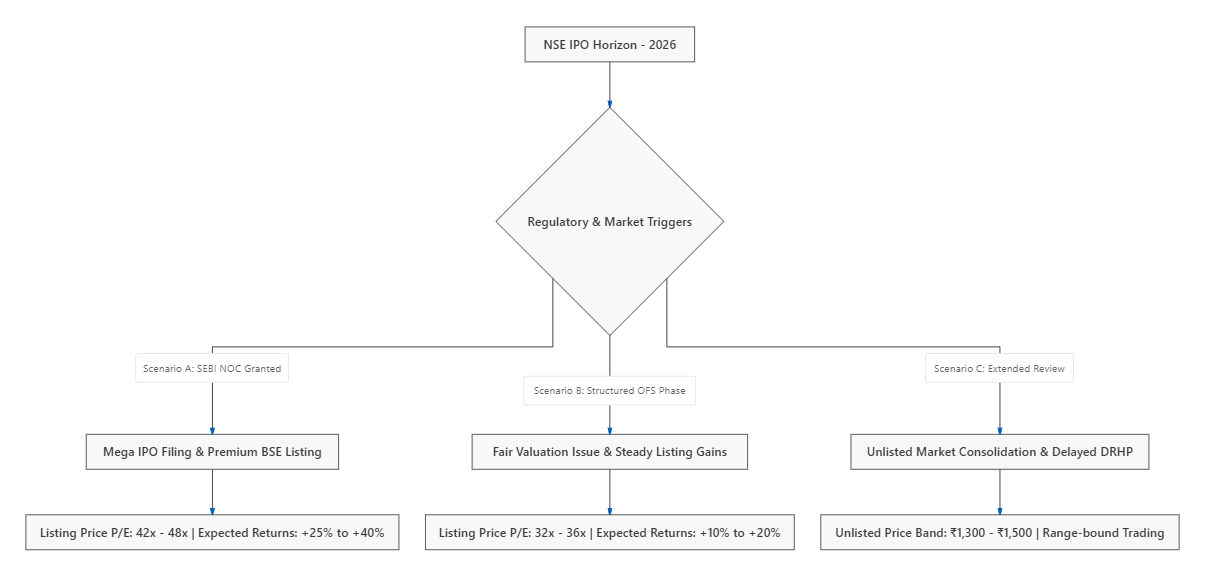
Scenario A: Bull Case – Mega Listing at Premium Valuation (50% Probability)
- Conditions: SEBI NOC granted smoothly; global markets remain supportive.
- Pricing & Valuation: IPO price set around 42x–48x TTM P/E, valuing NSE near ₹4.5 Lakh Cr ($54 Billion).
- Market Impact: Strong institutional demand leads to massive oversubscription across QIB and NII categories, triggering strong listing gains (+25% to +40%) on BSE.
Scenario B: Base Case – Moderated Valuation Issue (35% Probability)
- Conditions: SEBI clearance granted, but merchant bankers price the issue at reasonable multiples (32x–36x TTM P/E) to leave upside table space for retail investors.
- Pricing Range: Issue price around ₹1,400 – ₹1,550 per share.
- Market Impact: Healthy subscription numbers and stable post-listing performance (+10% to +20%).
Scenario C: Bear Case – Extended Regulatory Delays (15% Probability)
- Conditions: Additional governance audit directives or derivative volume slowdown delays the DRHP approval by a few quarters.
- Unlisted Market Impact: Unlisted shares consolidate within the ₹1,300 – ₹1,500 corridor until regulatory clarity emerges.
Actionable Investor Playbook
For Pre-IPO / Unlisted Share Investors
- Hold vs. Buy Decision: Investors who acquired unlisted shares at lower price points should hold for long-term compounding. Fresh entry in the unlisted market should account for illiquidity risks and the lock-in period (6 months for pre-IPO investors post-listing under SEBI rules).
For Retail & HNI IPO Applicants
- Capital Allocation Strategy: NSE represents a rare asset with near-monopolistic moats, stellar cash generation, and zero long-term debt. Applying across retail and HNI categories during the public issue offers high-conviction long-term portfolio addition.
❓ Frequently Asked Questions (FAQs)
NSE has completed major legal settlements and governance restructurings, and is awaiting the final No-Objection Certificate (NOC) from SEBI to file its Draft Red Herring Prospectus (DRHP).
NSE will list its shares on BSE Limited (Bombay Stock Exchange). Under SEBI regulations, a stock exchange cannot list on its own platform.
The IPO is expected to be an Offer for Sale (OFS) of ₹15,000 Crore to ₹30,000 Crore, making it one of the largest public issues in Indian history.
Following the 4:1 bonus issue in 2024, NSE shares trade in the unlisted market around ₹1,450 to ₹1,750 per share, implying a valuation of approximately ₹3.6 Lakh Cr to ₹4.4 Lakh Cr.
NSE generates revenue primarily from transaction fees on equity, futures, and options trading, followed by clearing fees, co-location revenue, listing fees, and market data licensing.
NSE operates an electronic exchange with high scalability. Once technology and clearing infrastructure are established, incremental trading volume generates revenue with minimal extra operating cost, resulting in EBITDA margins exceeding 75%.
Under SEBI ICDR regulations, pre-IPO shares held by non-promoters carry a 6-month lock-in period from the date of commercial allotment/listing.
BSE Limited currently trades at a TTM P/E multiple of ~48.5x, whereas NSE's unlisted share price implies a TTM P/E multiple of ~35x–42x, reflecting an attractive relative valuation given NSE's larger market share.
Key risks include SEBI regulatory interventions in F&O trading rules, transaction fee revisions, technology outages, and broad capital market volume cyclicality.
Yes. Due to its dominant market share (>93% cash, >98% options), robust balance sheet, high ROE (>34%), and structural growth in Indian retail equity participation, NSE is considered a marquee long-term compounder asset.
Financial & Regulatory Disclaimer
InvesTalks provides stock market analysis, equity research, and financial content strictly for educational and informational purposes only. We are not a SEBI-registered investment advisor or portfolio manager. Market investments are subject to market risks. Always perform your own research or consult a certified SEBI-registered financial advisor before making buy/sell decisions.
Admin
Equity Research & Financial AnalysisCurated by the InvesTalks financial analysis team. Dedicated to providing disciplined stock market insights, technical chart evaluations, and long-term investor education.
 Market News & Outlook
Login to comment.