
Index
- Introduction
- Executive Summary: Old vs. New NSE Pre-Open Session Framework
- What is the NSE Pre-Open Session & Why Does It Exist?
- Detailed Breakdown of the Revised 15-Minute Timelines (09:00 AM – 09:15 AM)
- How the Equilibrium Opening Price is Calculated (3-Step Algorithm)
- Why Did SEBI & NSE Update the Pre-Open Session Rules?
- Practical Impact & Execution Guide for Retail Traders
NSE Pre-Open Session New Rules: Timelines, Price & Impact
 By Admin
|
Sep 05, 2026
|
1 min read
|
84
|
🤍
0
By Admin
|
Sep 05, 2026
|
1 min read
|
84
|
🤍
0
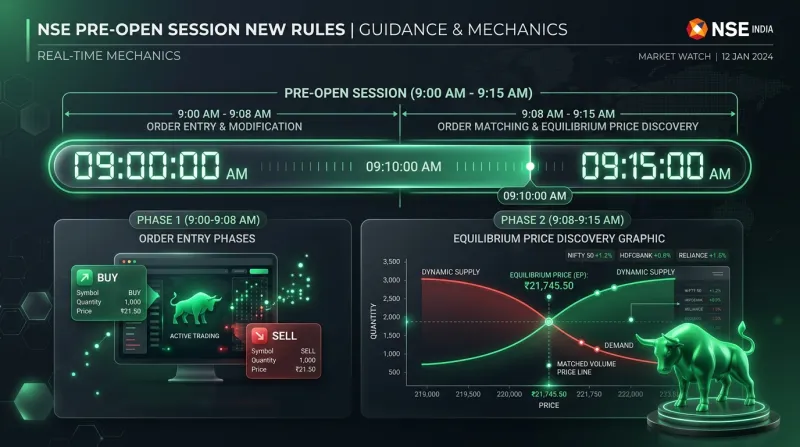
The National Stock Exchange of India (NSE), under guidelines from the Securities and Exchange Board of India (SEBI), has introduced structural changes to its 15-minute Pre-Open Market Session (09:00 AM to 09:15 AM).
Formalized via circular NSE/CMTR/74969, the new framework restructures the morning order-entry window into two distinct phases. This update aims to eliminate phantom orders and last-second price spoofing, while aligning the pre-market session with SEBI's Closing Auction Session (CAS) framework.
Whether you are a retail investor placing pre-market orders or an intraday trader tracking opening gap-ups and gap-downs, understanding these new mechanics is essential for managing execution risk.
In this comprehensive guide on Investalks.in, we provide a complete breakdown of the NSE Pre-Open Session New Rules, revised 15-minute phase timelines, the 3-step equilibrium price calculation algorithm, and practical execution strategies for traders.
Executive Summary: Old vs. New NSE Pre-Open Session Framework
| Pre-Open Feature | Old Pre-Open Framework | New Revised Framework (Circular 74969) |
|---|---|---|
| Order Entry Window | 09:00 AM – 09:08 AM (Single Phase) | 09:00 AM – 09:10 AM (Split 2-Phase) |
| Market Order Modification | Allowed up to 09:08 AM | Allowed ONLY in Phase 1 (09:00–09:05) |
| Market Order Placement | Allowed up to 09:08 AM | Phase 2 (09:05–09:10): Limit ONLY! |
| System Random Cutoff | Between 09:07 AM and 09:08 AM | Between 09:08 AM and 09:10 AM |
| Order Matching Window | 09:08 AM – 09:12 AM | 09:10 AM – 09:12 AM |
| Buffer Transition Period | 09:12 AM – 09:15 AM | 09:12 AM – 09:15 AM |
| Continuous Trading Start | 09:15:00 AM | 09:15:00 AM |
What is the NSE Pre-Open Session & Why Does It Exist?
 WHY THE PRE-OPEN SESSION MATTERS
  [ Overnight Global News / Corporate Announcements ]
                          │
                          ▼
  [ 09:00 AM – 09:15 AM Pre-Open Price Discovery ] ──► Absorbs Supply/Demand Imbalances
                          │
                          ▼
  [ 09:15 AM Continuous Trading Opening Bell ]    ──► Prevents Extreme Opening Slippage
Introduced to improve market efficiency, the Pre-Open Session (09:00 AM to 09:15 AM) is a 15-minute window preceding regular continuous trading:
- Absorbing Overnight Catalysts: Markets process corporate announcements, earnings results, and global cues (Wall Street closing prices, SGX/GIFT Nifty, Brent crude oil movement) before continuous trading opens.
- Preventing Opening Price Slippage: Without a pre-open session, high-volume orders placed at 09:15 AM would cause extreme price spikes and execution slippage.
- Determining a Single Opening Price: The pre-open session uses a single Equilibrium Price Discovery algorithm so that all matched orders execute at the same official opening price.
Detailed Breakdown of the Revised 15-Minute Timelines (09:00 AM – 09:15 AM)
| Time | Phase / Activity | Key Actions |
|---|---|---|
| 09:00 AM – 09:05 AM | Phase 1 (5 Min) | Market + Limit orders; Modify / Cancel |
| 09:05 AM – 09:10 AM | Phase 2 (5 Min) | LIMIT ONLY!; Market orders rejected |
| 09:10 AM – 09:12 AM | Matching | Price Calculation & Order Execution |
| 09:12 AM – 09:15 AM | Buffer Period | Transition; Ready for 09:15 AM trading |
| 09:15 AM | Continuous Trading | Regular market session begins |
Phase 1 (09:00 AM – 09:05 AM): Open Order Entry Window
- Allowed Order Types: Both Market Orders and Limit Orders can be placed, modified, or canceled.
- Trader Action: Retail investors who wish to place Market Orders (orders executing at whatever opening price is discovered) must submit them during this initial 5-minute window.
Phase 2 (09:05 AM – 09:10 AM): Restricted Limit-Only Window
- Allowed Order Types: Limit Orders ONLY.
- Strict Restrictions:
- New Market Orders cannot be placed.
- Existing Market Orders placed during Phase 1 cannot be modified or canceled.
- Any attempt to enter or alter a Market Order during Phase 2 will be automatically rejected by the exchange trading system.
- Purpose: This phase stabilizes the market order quantity, allowing traders to see true demand and supply using limit orders without fear of sudden market-order cancellations.
System-Driven Random Closure (09:08 AM – 09:10 AM)
- To prevent high-frequency trading (HFT) algorithms from manipulating order books at the last millisecond, the exchange system randomly closes the order-entry window at any point between 09:08 AM and 09:10 AM.
Order Matching & Price Discovery (09:10 AM – 09:12 AM)
- Once order entry closes, the exchange engine matches buy and sell orders to calculate the official Equilibrium Opening Price.
- Trades are executed at this single equilibrium price. Unmatched orders are carried forward to the continuous trading session at 09:15 AM based on their price-time priority.
Transition Buffer Period (09:12 AM – 09:15 AM)
- A 3-minute system transition window during which no new orders are accepted. The exchange prepares order books for regular continuous trading starting precisely at 09:15:00 AM.
How the Equilibrium Opening Price is Calculated (3-Step Algorithm)
 EQUILIBRIUM PRICE CALCULATION FLOWCHART
  [ STEP 1: Find Price with Maximum Executable Volume ]
                         │
                         ▼ (If multiple prices qualify)
  [ STEP 2: Find Price with Minimum Unmatched Order Imbalance ]
                         │
                         ▼ (If tie remains)
  [ STEP 3: Choose Price Closest to Previous Day's Closing Price ]
The exchange matching engine calculates the single Equilibrium Price using a 3-step priority algorithm:
- Step 1: Maximum Executable Volume (Primary Metric): The system tests all price points within the order book and identifies the price level where the highest number of shares can be matched and executed.
- Step 2: Minimum Unmatched Order Imbalance: If two or more price points yield the exact same executable volume, the system selects the price that results in the smallest unmatched order quantity (lowest imbalance).
- Step 3: Proximity to Previous Closing Price: If a tie still persists after Steps 1 and 2, the system selects the price point closest to the stock's previous trading day closing price.
Why Did SEBI & NSE Update the Pre-Open Session Rules?
REGULATORY OBJECTIVES & BENEFIT MATRIX
Eliminates Spoofing ──► Prevents fake large orders placed to mislead retail traders.
Restricts Phantom Orders ──► Blocks last-minute cancellations of large market orders.
Harmonizes Sessions ──► Aligns morning pre-open with afternoon Closing Auction (CAS).
1. Eliminating Algorithmic "Spoofing" and "Phantom Orders"
Under the old system, manipulative traders could place huge Market Buy or Market Sell orders at 09:01 AM to artificially inflate pre-open indicative prices, only to cancel them at 09:07:59 AM. By locking Market Orders after 09:05 AM, the new framework prevents phantom liquidity from misleading the market.
2. Protecting Retail Investors from Artificial Gaps
Retail investors often rely on indicative opening prices to make decisions. Restricting Phase 2 to Limit Orders ensures that the price discovery process reflects genuine supply and demand.
3. Harmonization with Closing Auction Session (CAS) Mechanics
SEBI recently mandated Closing Auction Sessions (CAS) for benchmark stocks to prevent end-of-day price manipulation. Updating the morning pre-open session creates a consistent operational standard across both opening and closing auctions. Read more market structure updates on Investalks.in Educational Guides.
Practical Impact & Execution Guide for Retail Traders
| Trader Scenario | Recommended Pre-Open Execution Strategy |
|---|---|
| Placing Market Orders | Submit between 09:00 AM and 09:04 AM. Do not wait past 09:05 AM! |
| Modifying Market Orders | Must be completed before 09:05:00 AM cutoff. |
| Placing Limit Orders | Can be placed up to 09:08 AM (Random closure applies up to 09:10 AM). |
| Unmatched Limit Orders | Automatically carried forward to continuous market at 09:15 AM. |
Key Takeaways for Investors:
- Never Delay Market Orders: If you intend to buy or sell at the official opening price using a Market Order, submit it immediately between 09:00 AM and 09:04 AM.
- Use Limit Orders for Price Protection: To avoid unexpected execution prices on volatile days, use Limit Orders during the pre-open session rather than unpriced Market Orders.
❓ Frequently Asked Questions (FAQs)
The pre-open session runs from 09:00 AM to 09:15 AM. Order entry is split into Phase 1 (09:00–09:05 AM for Market & Limit orders) and Phase 2 (09:05–09:10 AM for Limit orders ONLY). Order matching occurs between 09:10 AM and 09:12 AM, followed by a buffer period until 09:15 AM.
No. Under circular NSE/CMTR/74969, Market Orders cannot be placed, modified, or canceled during Phase 2 (09:05 AM to 09:10 AM). Any modification attempt will be automatically rejected by the system.
The opening (equilibrium) price is calculated using a 3-step algorithm: (1) Price with the maximum executable volume, (2) Price with the minimum unmatched order imbalance, and (3) Price closest to the previous day’s close.
Financial & Regulatory Disclaimer
InvesTalks provides stock market analysis, equity research, and financial content strictly for educational and informational purposes only. We are not a SEBI-registered investment advisor or portfolio manager. Market investments are subject to market risks. Always perform your own research or consult a certified SEBI-registered financial advisor before making buy/sell decisions.
Latest Stock Market News Today: Global & Local Drivers (Sept...
NEXTAcme Solar Holdings Analysis: Financials, Chart & Target
Admin
Equity Research & Financial AnalysisCurated by the InvesTalks financial analysis team. Dedicated to providing disciplined stock market insights, technical chart evaluations, and long-term investor education.
 Market News & Outlook
Login to comment.